
Landscape Curbing Planning · Oakton, VA
Concrete Landscape Curbing in Oakton VA: Plan the Bed Edges and Drainage
Concrete landscape curbing works best when its route, grade, drainage, finish, maintenance needs, access, and restoration are planned as one site-specific scope.
Published November 6, 2026 · Northern Virginia
Define what the curbing needs to accomplish
Walk the property and mark the planting beds, lawn edges, slopes, trees, downspouts, drainage paths, walkways, driveway, patios, utilities, and maintenance routes. Decide whether the curbing is primarily a finished border, a mowing edge, a material separator, or part of a broader landscape update.
Use a measured sketch and photographs to show the proposed beginning and ending points. Avoid treating every edge as one continuous line when gates, equipment access, roots, drainage routes, or other fixed conditions need a break or transition.
Lay out curves and transitions on the actual ground
A plan that looks smooth on paper can feel different beside a house, walkway, or sloped bed. Review the alignment from several viewing angles and confirm the relationship to siding, brick, steps, paving, planting beds, and lawn before forms or placement begin.
Identify tight curves, corners, grade changes, endpoints, and connections to other hardscape. The written scope should explain how those details are formed and finished rather than relying on an undefined total length.
Keep drainage and grade visible in the plan
Document where water appears to move during rain, where downspouts discharge, and whether mulch or soil has washed across the lawn or paving. Curbing should not be assumed to solve a drainage problem, and a new edge should not trap water against the house or block an established route without a site-specific plan.
Ask how excavation, base conditions, finished height, gaps or transitions, and neighboring surfaces are coordinated. More complex water or grade concerns may require additional design input beyond the curbing scope.
Choose color and finish beside the fixed materials
Compare samples outdoors next to the home's brick or siding, walkways, driveway, patios, stone, and mulch. Review them in sun and shade. Record the selected color, finish, texture, and any pattern or joint expectations in the agreement.
Concrete and other exterior materials can show natural variation. The proposal should describe the intended finish and sample-selection process without promising an exact match to a screen image, small sample, or older material.
Plan mowing, beds, and future landscape work
Discuss mower and trimmer access, mulch depth, planting changes, irrigation, low-voltage lighting, seasonal cleanup, and the path for wheelbarrows or garden equipment. A border should support how the property is maintained, not create an unexpected obstacle.
Identify who removes existing edging, relocates plants, adjusts soil or mulch, protects roots, restores lawn, and reconnects landscape features. Those responsibilities belong in the scope even when the curbing itself is the main visible improvement.
Use the Oakton project evidence to define a complete scope
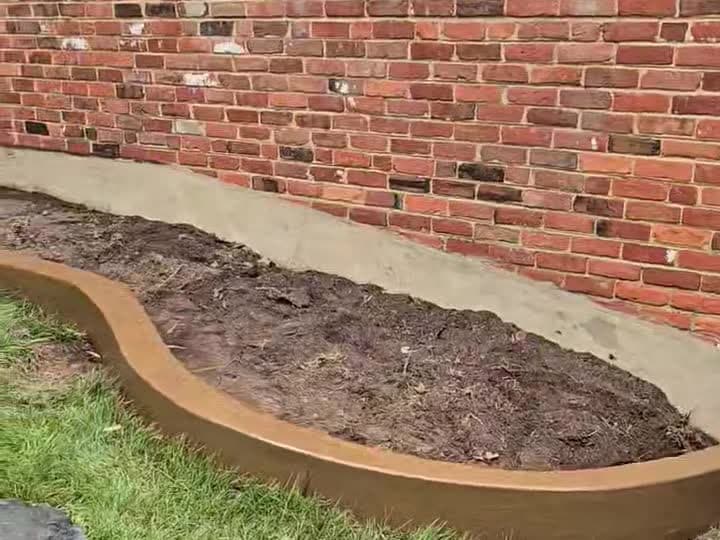
Concrete Commander has documented an Oakton project with curved, colored concrete landscape curbing installed around planting beds. The project photographs show the work during hand finishing, in forms, and after completion; they do not establish that the same layout or finish is right for another property.
For a new proposal, provide the edge map, site photos, drainage observations, finish selection, access route, protection needs, and restoration expectations. Ask the scope to itemize removal, excavation, preparation, forming, concrete, finish, joints, cleanup, restoration, exclusions, and the process for changed conditions.
Frequently Asked Questions
Can concrete curbing be placed around every planting bed?
The route should be reviewed for roots, grade, drainage, utilities, access, neighboring hardscape, and maintenance needs before the scope is confirmed.
Will landscape curbing fix a drainage problem?
It should not be assumed to. Existing water paths and proposed finished heights need site-specific review, and broader drainage concerns may require separate work.
How should the curbing color be selected?
Review physical samples outdoors beside the home's fixed exterior materials and record the selected color and finish, while allowing for the natural variation of exterior materials.
Has Concrete Commander completed curbing work in Oakton?
Yes. The Oakton project gallery documents curved, colored concrete landscape curbing around planting beds.
Related Planning Resources
Map the bed edges before pricing curbing
Share the Oakton edge layout, site photos, drainage observations, finish preferences, access route, and restoration needs. Concrete Commander can review the curbing scope.
Request a Concrete Consultation